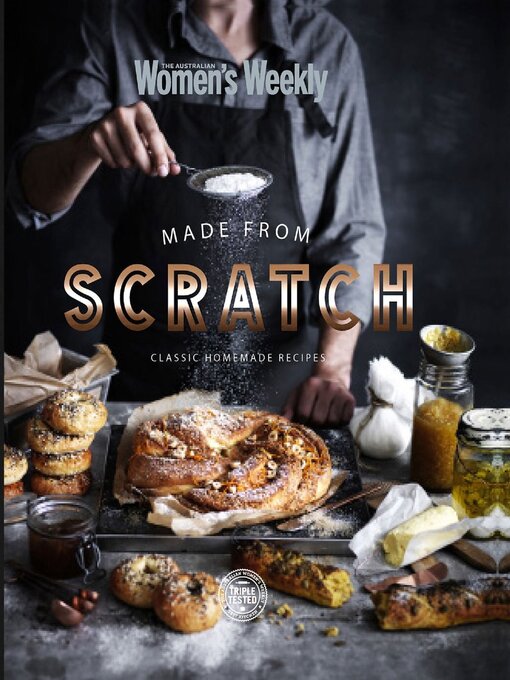
What does it mean ‘made from scratch’? It’s taking basic ingredients – milk, flour, sugar, eggs, meats, vegetables, fruits – and turning them into something most convenience products lack...food jam-packed with flavour. We remember back in our grandmother’s day: the taste of bread that only comes from being slowly proved on the kitchen bench before baking; the preserves, bursting with full, in-season flavour, that end up filling freshly-made sandwiches and cakes; the saltiness of handmade cheese and bacon. Sentimental it may be, but the taste, flavour, freshness and piquancy of the food… that still remains. Making food from scratch is not always hard, and it’s not always time consuming, but yes, it can be. Quality can’t be rushed, time and care must be taken; this is how it is.
The Australian Women’s Weekly: Made from Scratch
FRESHLY MADE • classic homemade recipes
CREAMY CURDS O WHEY • CHAPTER no.1
ALL ABOUT CHEESE • All cheese begins with milk, and employs a process of fermentation that is, in essence, simple enough to master so that you can produce fresh cheese and cultured dairy products at home, and a few more slightly complex ones with relative ease.
BOUNTIFUL PRESERVES O JAMS • CHAPTER no.2
MAKING PRESERVES • Plan to make jam when fruit is at its peak so you are using fresh local produce at its prime – that way you can savour the flavours year round. Jams, conserves and marmalades are made from a single or several types of fruit (or vegetables). A conserve is a jam that contains large pieces of fruit, while marmalade is simply a jam made from citrus fruit.
GRIND THE GRAIN FLOUR O STONE • CHAPTER no.3
ALL ABOUT BREAD • Of all foodstuffs we love to eat, few evoke more emotion than bread. At its simplest, this staple is little more than wheat flour, water and leavening (which is simply a raising agent), yet these three ingredients are open to myriad interpretations producing differing breads, and that’s before introducing the possibility of different flours and flavours.
PRESERVATION SALT O CURE • CHAPTER no.4
ALL ABOUT CURING • Long before modern-day conveniences, such as fridges and freezers, salt was used as a preservative, allowing food to last from season to season. These recipes hark back to this simpler era, when all that was required from the cook was patience and a little time spent waiting.
THE PICKLED PANTRY • CHAPTER no.5
MAKING PICKLES • Pickling is a method of preserving raw or quickly blanched vegetables and fruits in vinegar or alcohol (distilled spirits). Both liquids penetrate the ingredients, replacing the natural liquid, to prevent the growth of micro-organisms that would otherwise spoil foods. For safety reasons, the amount of vinegar and sugar in a recipe should never be altered.
THE SMOKEHOUSE • CHAPTER no.6
ALL ABOUT SMOKING • Smoking adds a rich layer of flavour, increasing the umami effect and making foods more savoury. Smoke is made of many things, some of which inhibit the growth of microbes, and others that retard oxidisation of fat. This is what makes it a preservative, usually in combination with salt.
DELICIOUS - GRIND O PRESS • CHAPTER no.7
MAKING PASTES • This chapter contains recipes that are the building blocks of the kitchen – condiments, rubs, pastes, seasonings and stand-alone recipes. If you have these on hand, meal times will never be dull.
STERILISING INFORMATION • Sterilising equipment is important when making any of the recipes in the book. Not only does proper sterilisation prolong the life of your product, it is also extremely important in preventing food-borne bacteria from causing severe illness.
GLOSSARY
CONVERSION CHART